

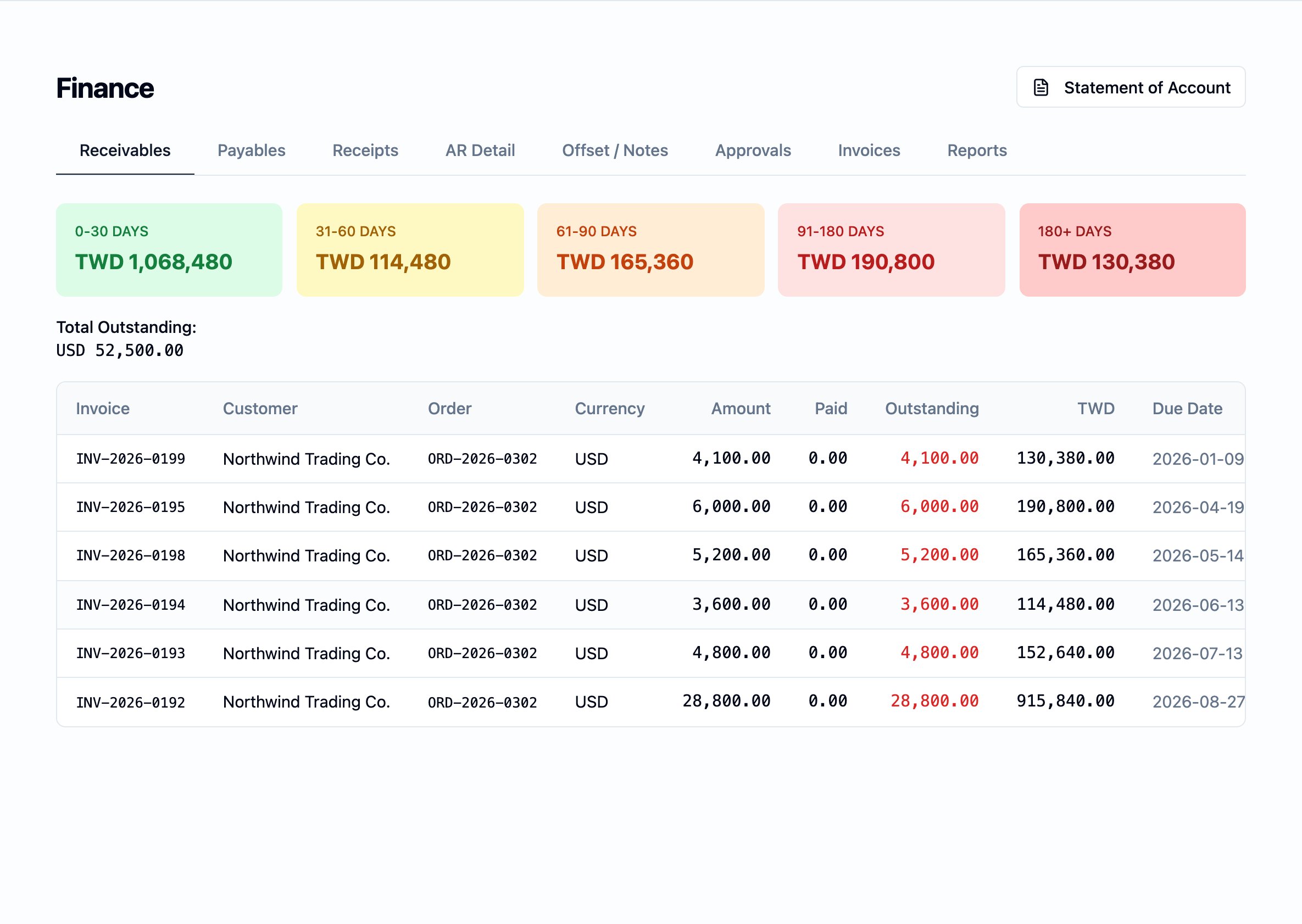
The Receivables board — five aging-bucket cards across the top, the per-currency total below, and one row per open customer document underneath.
What this board is
Receivables is a working board, not a ledger. Every figure on it is read off the finance ledger — the canonical record of every money movement on the workspace — and presented in the shape finance teams need for day-to-day collection work: one row per open customer document, the running aging on each row, and the currency-by-currency sub-totals across the top. The board lists every customer document that has an outstanding amount: a customer invoice that has not been fully paid, a debit note that has not been settled, or a credit note that has not yet been applied. A document leaves the board the moment its outstanding amount falls to zero — the document itself stays on file, but the receivables view is for open work.Why it exists
In a typical apparel order the customer pays in two parts — a deposit at the proforma stage and a balance after shipment — and the gap between the two runs across several months. Across a busy workspace those gaps overlap, sit in different currencies, and age at different rates. Receivables is the one place the team can stand to see the full picture: who owes, how much, in which currency, and how overdue.What the board shows
The Receivables tab opens with two layered views: a strip of aging-bucket summary cards across the top, and a detail table of every open customer document below.The aging-bucket cards
Five summary cards along the top group every open document by how long it has been outstanding. The bands and the rule that places a row into each are canonical for the workspace, and shared with the Statement of Account and the Payables board. See Aging buckets for the full definition.The detail table
Below the cards, a single table lists every open customer document. Each row carries:Invoice— the document’s own number (a customer invoice number, a debit note number, or a credit note number).Customer— the customer the document is raised against.Order— the order the document was raised from.Currency— the currency the document is denominated in.Amount— the document’s total amount in its own currency.Paid— what has already been received against this document, in the document’s currency.Outstanding— what is still owed on the document, in the document’s currency.- A second outstanding column in the workspace’s reporting currency, at the rate that was in effect when the document was booked — so a row in EUR or USD can be read alongside the workspace’s own money without re-keying.
Due Date— the date the customer is expected to settle the document by.Bucket— the aging bucket the row currently falls in, computed from the due date. See Aging buckets.
How a balance is opened, reduced, and closed
A row appears on this board the moment a customer document is raised. It reduces as receipts and credits are applied. It disappears when the outstanding amount reaches zero.- A balance is opened by a charge raised. When a customer invoice or a
debit note is issued, a charge raised entry is written to the
receivables side of the finance ledger. The
document appears on this board the same moment, with the full charged
amount carried in the
Outstandingcolumn. - A balance is reduced by a receipt. When the team records a customer
receipt against the document — recorded on the Receipts (收款 / 收款)
tab — the matching receipt entry is written to the ledger and the row’s
Paidcolumn rises by the same amount. TheOutstandingcolumn drops. - A balance is also reduced by an applied deposit. When an unapplied customer deposit is applied against an invoice — recorded on the Offset / Notes (沖帳 / 冲账) tab — the application is written to the ledger and the row updates the same way. Deposits and receipts both reduce the outstanding amount.
- A balance is reduced by a credit note. A credit note issued to the customer settles against an open invoice the same way an applied deposit does: the credit reduces the invoice’s outstanding amount and, once the invoice is settled in full, the row drops off the board.
- A balance is closed when the outstanding amount reaches zero. The row leaves the board automatically; the document itself remains under Invoices for reference.
How currency is presented
The board never blends one customer’s USD outstanding into another’s TWD outstanding. Every row shows its document in its own currency, and the sub-totals above the table list each currency separately.- The detail table shows the
Outstandingcolumn twice — once in the document’s own currency, and once in the workspace’s reporting currency at the rate that was in effect on the document’s date. Both views read the same row; neither one is converted on the fly to reflect today’s rate. - The
Total Outstandingline at the top of the table is broken out by currency. A workspace that invoices in TWD, USD, and EUR will see three sub-totals — one per currency — rather than a single blended figure. The rule is shared with the per-currency aging sub-totals; see Aging buckets. - Foreign-exchange differences between the rate at which a document was booked and the rate at which it is paid are recorded on the foreign-exchange side of the finance ledger, not folded back into the customer’s outstanding balance. The customer continues to owe whatever the document says in its own currency.
Who reaches the Receivables board
The Receivables board is open to the Finance, Finance checker, Administrator, and Supervisor roles. Sales and Merchandiser users do not reach the Finance module at all. The Supervisor role sees the board read-only. See User management for the full role catalogue and what each role may do here.Where it sits in the workflow
Receivables is downstream of the order surfaces and upstream of the customer statement.- Upstream. A customer invoice raised from a shipment, a debit note issued to charge the customer for something owed back, and the proforma deposit on a confirmed order are all the events that open a balance on this board. See Orders and Shipments.
- Across. Receipts are recorded on the Receipts (收款) tab; advance receipts are applied to invoices on the Offset / Notes (沖帳) tab. Both surfaces write the entries that reduce the rows on this board.
- Downstream. The Statement of Account the workspace sends a customer reads the same charges, receipts, and balances this board surfaces, in a customer-facing format. See Statement of Account.