

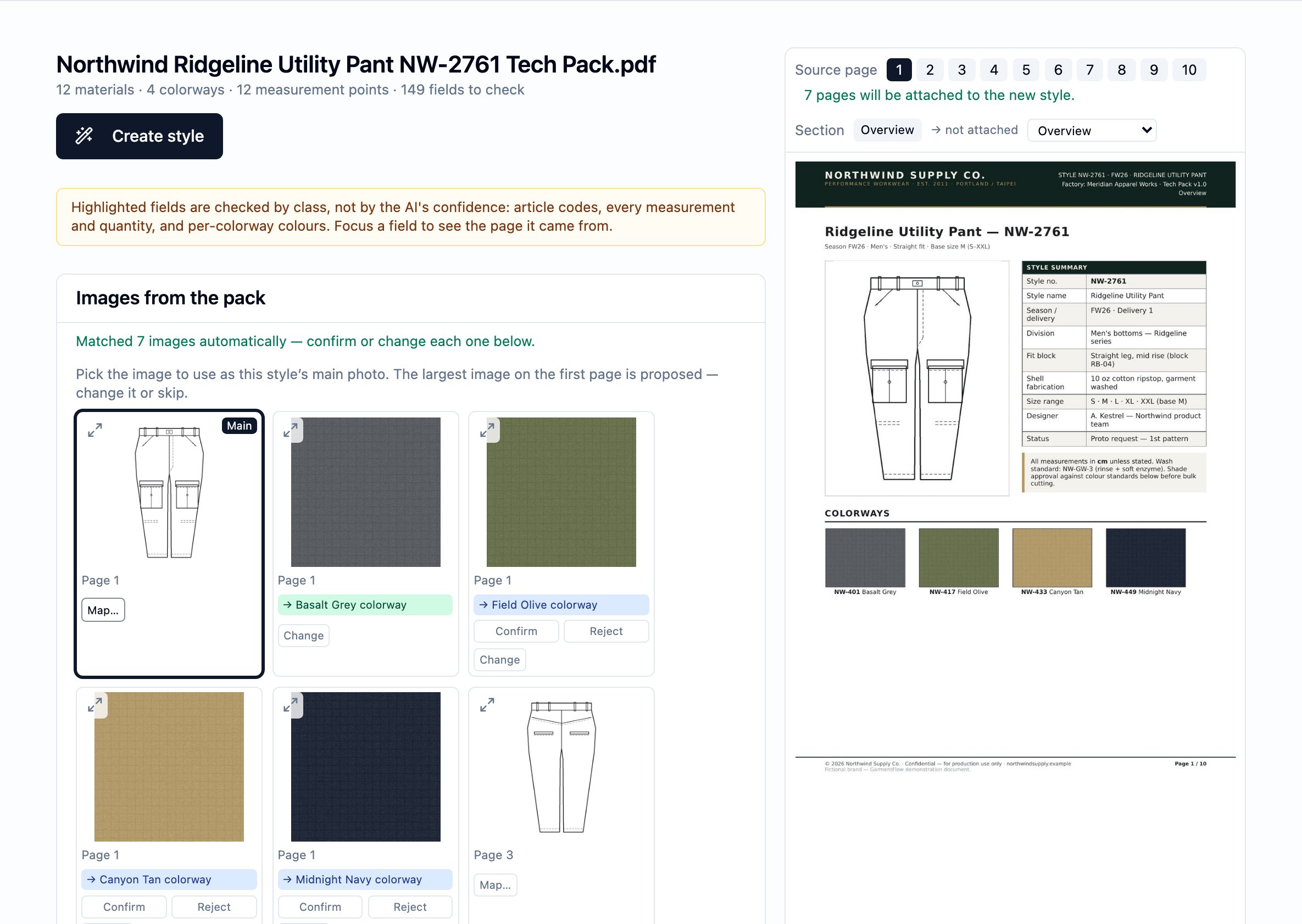
The middle of the chain — the review screen where the brand's authored pack becomes a working style, reader beside every field its own source page.
The two halves
The commitment side of the chain is the same for every style your workspace runs: a becomes a customer , the order carries the per-colorway × per-size quantities and the destination, and the order’s carries the per-run binding. The commercial cycle is the canonical page for the document chain that produces it. The specification side, for a style that originated from a brand’s authored pack, is what this page adds. GarmentFlow’s Tech Packs module is the receiving side of that pack, and — together with the existing Style model — is where the specification is assembled. When the two halves meet on the factory work order, the OEM prints one document containing both.The chain, in order
- The brand sends a pack, or a
.tpvexport. A PDF, an Illustrator (.ai) file, or a Techpacker.tpvexport lands in the merchandiser’s inbox. It is what the brand authored; it is not yet a style. - The pack is uploaded to Tech Packs. The file goes straight to secure
storage, and the system reads it. For a PDF or
.aifile, fields, image matches and QC checks are proposed; for a.tpvfile, every field is read from the file rather than inferred, and no proposal is made. See Import a tech pack. - You review the pack on its own pages. Beside the pack’s page renders, you confirm the identity, the colorways, the BOM lines and their links to your existing material masters, the size-specification points and tolerances, which images are colorway swatches and which belong to BOM rows, which instruction pages will attach to the new style’s Packing and Production Notes surfaces, and which proposed QC checks to keep. Nothing lands until you confirm.
- You inject the pack. The confirmed content is written as a new style: its identity and colorways, its BOM, its style-level size specification (the POM record on the style itself, seeded from the pack’s tolerance table — a separate surface from any per-order grading table), the pack’s own images (with your chosen main photo as the ), the classified instruction pages as attachments on the style’s Packing and Production Notes tabs, and the confirmed QC checklist on the style’s QC tab. From this point on, the pack’s role is background — the style is the working record.
- The style runs the ordinary path. A sample is developed and fitted; a quotation is priced; the customer places an order; a manufacturing order is opened against a specific order version. Nothing in this stretch differs because the style came from a pack — the style is a style.
- You generate the factory work order. From the MO on a tech-pack-originated style, you produce a single A4 PDF: the OEM’s cover (order header, per-size × per-colorway quantity matrix, the confirmed QC checklist) followed by the pack’s own pages. This is the document the factory works to. See Generate the factory work order.
Where the reader encounters each hop
- In the Tech Packs list. The upload card and the pack list are the entry point. Each pack’s row shows a per-stage processing status — processing pages and images, reading the pack, matching images to colorways and BOM rows, classifying pages, building the QC checklist — until the pack is ready to review, then injected.
- On the review screen. One long form, section by section, with the pack’s own pages open beside every field.
- On the created style. The style behaves like any other style. Its origin is visible in the pack’s images (the hero and the gallery), in the attachments on the Packing and Production Notes tabs, and in the imported checklist on the QC tab.
- On the style’s MO tab. For an order-bound MO of a tech-pack-originated style, a Download PDF action opens the work-order generate flow.
- On the printed work order. The cover carries the OEM’s own header, the quantity matrix, the destinations and the QC checklist; the body carries the brand’s authored pages.
The two forms of the MO document
The manufacturing order carries two artifacts, both grounded on the same confirmed data, and both can be produced for the same MO:- The 8-tab Excel workbook — the multi-tab factory spec workbook that every style has always been able to produce. See Build a manufacturing order (MO).
- The A4 PDF work order (製造單) — the second form, available only when the MO is order-bound and the style originated from a tech pack. See Generate the factory work order.