> ## Documentation Index
> Fetch the complete documentation index at: https://docs.garmentflow.ai/llms.txt
> Use this file to discover all available pages before exploring further.
# Finance
> The money side of the order — what customers owe, what you owe vendors, the receipts and payments that settle them, and the invoices, debit and credit notes, and reports that record the work.
The **Finance** module is the money side of GarmentFlow. It runs the workspace's
receivables and payables, records the receipts and payments that settle them,
issues the invoices and the debit and credit notes that document the work, and
produces the statements and reports finance teams need to close the month.
 ## What this module is
Finance is where the money attached to an
[order](/reference/glossary#order)
becomes real. Selling a style produces a charge a customer owes you; buying
materials produces a charge you owe a vendor; the receipts and payments that
follow settle each side; corrections, returns, and rebates are recorded as
debit and credit notes; and every figure the team relies on — aging, balances,
statements, and the export to your bookkeeping system — is read off the same
source.
That source is the [finance ledger](/concepts/finance-ledger), the canonical
record of every money movement in the workspace. Every screen in this module
either records a movement to the ledger or reads from it; the ledger keeps the
balances honest.
## Why it exists
An apparel order travels through several months between the day it is
confirmed and the day it is paid. Deposits and balance receipts arrive at
different times, vendor invoices for fabric and trims accrue ahead of
shipment, freight and inspection invoices land late, and many of the
documents are in a currency that is not your workspace's reporting currency.
Finance is the place that holds all of those moving parts in one consistent
view so the team can answer two questions at any moment: **what is owed to
us** and **what do we owe**.
## How it relates to orders and production
Finance does not originate orders or production work — it records the money
that flows from them.
* **Orders** create the customer-side activity Finance records: a proforma
invoice opens the deposit, a commercial invoice raises the balance charge,
and customer receipts close those charges out. See
[Orders](/modules/orders).
* **Production** creates the vendor-side activity Finance records: factory and
trim suppliers raise invoices against the manufacturing orders and the
non-production costs that ship the goods (freight, inspection, customs,
packaging, testing), and vendor payments close those charges out. See
[Production](/modules/production).
* **Shipments** trigger the commercial invoice the customer is billed against.
See [Shipments](/modules/shipments).
A change made elsewhere in the platform — confirming an order, posting a
receipt, approving a vendor payment — is recorded as a movement on the finance
ledger as part of the same save.
## The Finance module surfaces
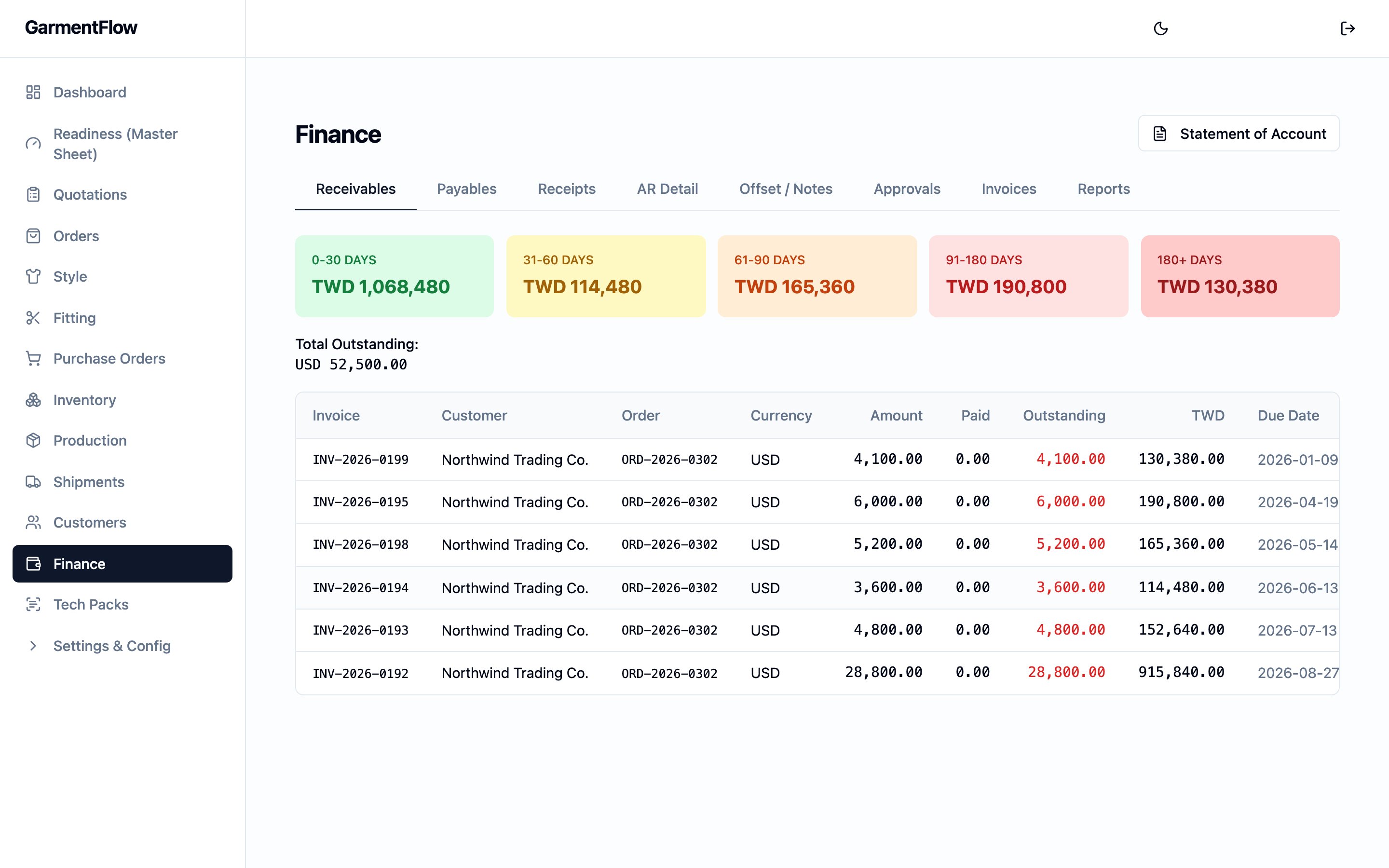
The module opens on a single tabbed landing. Each tab is one finance surface;
they share the ledger underneath, so a movement recorded on one is visible on
every other that reads it. The list below names each surface — the full
behavior of each one is covered on its own page in this section.
* **[Receivables](/modules/receivables).** The aging board for what customers
owe you, organised into age buckets so the team can see what is current,
what is approaching due, and what is overdue. The unreconciled-receivables
worklist sits here.
* **[Payables](/modules/payables).** The aging board for what you owe
vendors, with the same bucketing and worklist treatment.
* **Receipts.** The screen for recording money received from a customer
against one or more invoices, including batch receipts that settle several
invoices at once and the application of an advance deposit against an
invoice raised later.
* **AR Detail.** A per-customer drill-down on receivables — open invoices,
outstanding balance, and the path into a customer statement.
* **Offset / Notes.** Where deposits and advance receipts are applied against
invoices, and where **[debit notes](/modules/debit-credit-notes)** and
**[credit notes](/modules/debit-credit-notes)** are issued and managed.
* **Approvals.** The approval worklist for finance documents that need a
second signature — vendor payments and debit and credit notes. The tab is
shown only to the **Finance checker** and the **Administrator** roles, and a
submitter never sees their own items on it. See
[Maker-checker approvals](/admin/user-management#maker-checker-approvals).
* **[Invoices](/modules/invoices).** The list of customer invoices and the
[debit and credit notes](/modules/debit-credit-notes) attached to them.
* **[Reports](/modules/finance-reports).** The Finance reporting layer — a
per-order cost-sheet view, the AP summary, the gross-margin and
expense-analysis reports, and the
[Order Profit and Customer Profit](/modules/finance-reports#order-profit-and-customer-profit)
roll-ups that read the workspace's
[cost allocation](/concepts/cost-allocation) overlay. Reports export to
Excel and CSV; a separate back-office
[正航 / ChengHang T357 voucher export](/reference/t357-voucher-export) is
available for workspaces that book their accounts in that system.
A **[Statement of Account](/modules/statement-of-account)** action on the
header lets finance generate the customer-facing statement (對帳單) for any
customer, drilled in from the Receivables tabs or opened directly.
Which tabs a given user sees also depends on their role: the **Finance** and
**Finance checker** roles run this module as their main workspace; the
**Administrator** reaches every surface; the **Supervisor** sees every figure
read-only; **Sales** and **Merchandiser** users do not reach the module at
all. See [User management](/admin/user-management) for the full role rules.
## Foreign currency
Many apparel workspaces invoice and pay in a mix of currencies. Finance
records every movement in the document's own currency and, on the same
movement, the equivalent in the workspace's reporting currency at the rate in
effect on the document's date — so balances can be read in either view. When
the rate at payment differs from the rate that was booked when the invoice
was raised, the difference is recorded as a realized foreign-exchange gain or
loss on the ledger, in the reporting currency. See
[Foreign exchange](/modules/foreign-exchange) for the full behaviour —
including the FX-rate re-stamp that runs when an order's currency is changed
and the base currency every Finance figure reconciles to —
[FX Rates](/admin/fx-rates) for how rates are managed, and the
[finance ledger](/concepts/finance-ledger) for how the gain or loss is
recorded.
## Approvals on finance documents
Three Finance documents are gated by the workspace's **maker-checker** model:
**vendor payments**, **debit notes**, and **credit notes**. The person who
prepares the document is the **maker**; a different person must approve it
as the **checker**, and the same user can never play both parts on the same
document. The full rule — who may act in each part, the lifecycle, and the
worklist that surfaces pending items — is on
[Maker-checker approvals](/admin/user-management#maker-checker-approvals).
This module enforces it; the rule itself is canonical there.
## Key concepts
* [The finance ledger](/concepts/finance-ledger) — the single record behind
every figure in this module.
* [Aging buckets](/reference/aging-buckets) — the five-band aging rule and
the per-currency sub-total rule shared by every Finance view.
* [Cost allocation](/concepts/cost-allocation) — how the workspace's
non-production costs are attributed across an order's styles so the
loaded-cost profitability roll-ups can be read.
* [Maker-checker approvals](/admin/user-management#maker-checker-approvals) —
the dual-control rule on vendor payments and debit and credit notes.
* [FX rates](/admin/fx-rates) — how rates are entered and how the workspace's
reporting currency is chosen.
## Related pages
* [Receivables](/modules/receivables)
* [Payables](/modules/payables)
* [Invoices](/modules/invoices)
* [Debit and credit notes](/modules/debit-credit-notes)
* [Statement of Account](/modules/statement-of-account)
* [Foreign exchange](/modules/foreign-exchange)
* [Finance reports](/modules/finance-reports)
* [Cost allocation](/concepts/cost-allocation)
* [正航 / ChengHang T357 voucher export](/reference/t357-voucher-export)
* [The finance ledger](/concepts/finance-ledger)
* [Orders](/modules/orders)
* [Production](/modules/production)
* [Shipments](/modules/shipments)
* [User management](/admin/user-management)
* [FX rates](/admin/fx-rates)
## What this module is
Finance is where the money attached to an
[order](/reference/glossary#order)
becomes real. Selling a style produces a charge a customer owes you; buying
materials produces a charge you owe a vendor; the receipts and payments that
follow settle each side; corrections, returns, and rebates are recorded as
debit and credit notes; and every figure the team relies on — aging, balances,
statements, and the export to your bookkeeping system — is read off the same
source.
That source is the [finance ledger](/concepts/finance-ledger), the canonical
record of every money movement in the workspace. Every screen in this module
either records a movement to the ledger or reads from it; the ledger keeps the
balances honest.
## Why it exists
An apparel order travels through several months between the day it is
confirmed and the day it is paid. Deposits and balance receipts arrive at
different times, vendor invoices for fabric and trims accrue ahead of
shipment, freight and inspection invoices land late, and many of the
documents are in a currency that is not your workspace's reporting currency.
Finance is the place that holds all of those moving parts in one consistent
view so the team can answer two questions at any moment: **what is owed to
us** and **what do we owe**.
## How it relates to orders and production
Finance does not originate orders or production work — it records the money
that flows from them.
* **Orders** create the customer-side activity Finance records: a proforma
invoice opens the deposit, a commercial invoice raises the balance charge,
and customer receipts close those charges out. See
[Orders](/modules/orders).
* **Production** creates the vendor-side activity Finance records: factory and
trim suppliers raise invoices against the manufacturing orders and the
non-production costs that ship the goods (freight, inspection, customs,
packaging, testing), and vendor payments close those charges out. See
[Production](/modules/production).
* **Shipments** trigger the commercial invoice the customer is billed against.
See [Shipments](/modules/shipments).
A change made elsewhere in the platform — confirming an order, posting a
receipt, approving a vendor payment — is recorded as a movement on the finance
ledger as part of the same save.
## The Finance module surfaces
The module opens on a single tabbed landing. Each tab is one finance surface;
they share the ledger underneath, so a movement recorded on one is visible on
every other that reads it. The list below names each surface — the full
behavior of each one is covered on its own page in this section.
* **[Receivables](/modules/receivables).** The aging board for what customers
owe you, organised into age buckets so the team can see what is current,
what is approaching due, and what is overdue. The unreconciled-receivables
worklist sits here.
* **[Payables](/modules/payables).** The aging board for what you owe
vendors, with the same bucketing and worklist treatment.
* **Receipts.** The screen for recording money received from a customer
against one or more invoices, including batch receipts that settle several
invoices at once and the application of an advance deposit against an
invoice raised later.
* **AR Detail.** A per-customer drill-down on receivables — open invoices,
outstanding balance, and the path into a customer statement.
* **Offset / Notes.** Where deposits and advance receipts are applied against
invoices, and where **[debit notes](/modules/debit-credit-notes)** and
**[credit notes](/modules/debit-credit-notes)** are issued and managed.
* **Approvals.** The approval worklist for finance documents that need a
second signature — vendor payments and debit and credit notes. The tab is
shown only to the **Finance checker** and the **Administrator** roles, and a
submitter never sees their own items on it. See
[Maker-checker approvals](/admin/user-management#maker-checker-approvals).
* **[Invoices](/modules/invoices).** The list of customer invoices and the
[debit and credit notes](/modules/debit-credit-notes) attached to them.
* **[Reports](/modules/finance-reports).** The Finance reporting layer — a
per-order cost-sheet view, the AP summary, the gross-margin and
expense-analysis reports, and the
[Order Profit and Customer Profit](/modules/finance-reports#order-profit-and-customer-profit)
roll-ups that read the workspace's
[cost allocation](/concepts/cost-allocation) overlay. Reports export to
Excel and CSV; a separate back-office
[正航 / ChengHang T357 voucher export](/reference/t357-voucher-export) is
available for workspaces that book their accounts in that system.
A **[Statement of Account](/modules/statement-of-account)** action on the
header lets finance generate the customer-facing statement (對帳單) for any
customer, drilled in from the Receivables tabs or opened directly.
Which tabs a given user sees also depends on their role: the **Finance** and
**Finance checker** roles run this module as their main workspace; the
**Administrator** reaches every surface; the **Supervisor** sees every figure
read-only; **Sales** and **Merchandiser** users do not reach the module at
all. See [User management](/admin/user-management) for the full role rules.
## Foreign currency
Many apparel workspaces invoice and pay in a mix of currencies. Finance
records every movement in the document's own currency and, on the same
movement, the equivalent in the workspace's reporting currency at the rate in
effect on the document's date — so balances can be read in either view. When
the rate at payment differs from the rate that was booked when the invoice
was raised, the difference is recorded as a realized foreign-exchange gain or
loss on the ledger, in the reporting currency. See
[Foreign exchange](/modules/foreign-exchange) for the full behaviour —
including the FX-rate re-stamp that runs when an order's currency is changed
and the base currency every Finance figure reconciles to —
[FX Rates](/admin/fx-rates) for how rates are managed, and the
[finance ledger](/concepts/finance-ledger) for how the gain or loss is
recorded.
## Approvals on finance documents
Three Finance documents are gated by the workspace's **maker-checker** model:
**vendor payments**, **debit notes**, and **credit notes**. The person who
prepares the document is the **maker**; a different person must approve it
as the **checker**, and the same user can never play both parts on the same
document. The full rule — who may act in each part, the lifecycle, and the
worklist that surfaces pending items — is on
[Maker-checker approvals](/admin/user-management#maker-checker-approvals).
This module enforces it; the rule itself is canonical there.
## Key concepts
* [The finance ledger](/concepts/finance-ledger) — the single record behind
every figure in this module.
* [Aging buckets](/reference/aging-buckets) — the five-band aging rule and
the per-currency sub-total rule shared by every Finance view.
* [Cost allocation](/concepts/cost-allocation) — how the workspace's
non-production costs are attributed across an order's styles so the
loaded-cost profitability roll-ups can be read.
* [Maker-checker approvals](/admin/user-management#maker-checker-approvals) —
the dual-control rule on vendor payments and debit and credit notes.
* [FX rates](/admin/fx-rates) — how rates are entered and how the workspace's
reporting currency is chosen.
## Related pages
* [Receivables](/modules/receivables)
* [Payables](/modules/payables)
* [Invoices](/modules/invoices)
* [Debit and credit notes](/modules/debit-credit-notes)
* [Statement of Account](/modules/statement-of-account)
* [Foreign exchange](/modules/foreign-exchange)
* [Finance reports](/modules/finance-reports)
* [Cost allocation](/concepts/cost-allocation)
* [正航 / ChengHang T357 voucher export](/reference/t357-voucher-export)
* [The finance ledger](/concepts/finance-ledger)
* [Orders](/modules/orders)
* [Production](/modules/production)
* [Shipments](/modules/shipments)
* [User management](/admin/user-management)
* [FX rates](/admin/fx-rates)