> ## Documentation Index
> Fetch the complete documentation index at: https://docs.garmentflow.ai/llms.txt
> Use this file to discover all available pages before exploring further.
# Build the BOM
> Open, fill, and approve a BOM version on a style — the certified material list that the cost sheet copies from and that seeds draft purchase orders.
A [BOM](/reference/glossary#bom-bill-of-materials)
is how a
[style](/reference/glossary#style)
is made: the list of fabrics and trims that go into one piece. Build a BOM
version and get it approved so the
[cost sheet](/modules/cost-sheet) can copy from it and procurement can act on
it.
## What this workflow achieves
You end this workflow with a saved, approved BOM version on the style: a
material list, with each line pointed at a fabric or accessory master, that
the
[cost sheet](/modules/cost-sheet) copies from and that the platform reads to
seed a draft
[purchase order](/reference/glossary#po-purchase-order)
for each vendor — each PO line carries the BOM line's material, the resolved
vendor, the order's quantity for that line, and the unit price captured from
the linked fabric or accessory master at approval.
When the version is the first approval on the style and was created in an
[order](/reference/glossary#order)
context, that order's phase advances to **Procurement** the moment the BOM
is approved.
## When to use it
* A style has been developed and needs its first BOM version before the
cost sheet and the procurement side can start.
* The material list has changed — a fabric is swapped, a trim is added, a
supplier is renegotiated — and a new version needs to be opened so the
next cost-sheet revision and the next draft purchase orders pick it up.
* A BOM was approved earlier and now needs a correction — revert it to
**Draft**, fix the lines, and approve again.
If the style does not yet exist, develop it first — see
[Develop a style](/modules/develop-a-style).
## Prerequisites
* **A style** the BOM will belong to. Every BOM is one style's BOM. See
[Develop a style](/modules/develop-a-style).
* **A fabric master record for each fabric line, and an accessory master
record for each accessory line.** Free-text lines are permitted, but a
line without a linked master has no resolvable supplier and is dropped by
draft purchase-order generation downstream. Your administrator manages
the master records.
* **BOM write permission**, for the user opening a version, editing lines,
or approving. Reads are open to any authenticated user in your tenant.
## Roles involved
Users with BOM write permission open BOM versions, add and edit lines, link
the fabric or accessory master on each line, and approve or revert a
version. The platform gates write and approval actions by **capability**,
not by job title — sales, merchandising, and administrator roles that carry
the capability may all certify the BOM. Anyone authenticated to your tenant
can open a saved BOM, read it, and see the material list it carries.
## Step-by-step
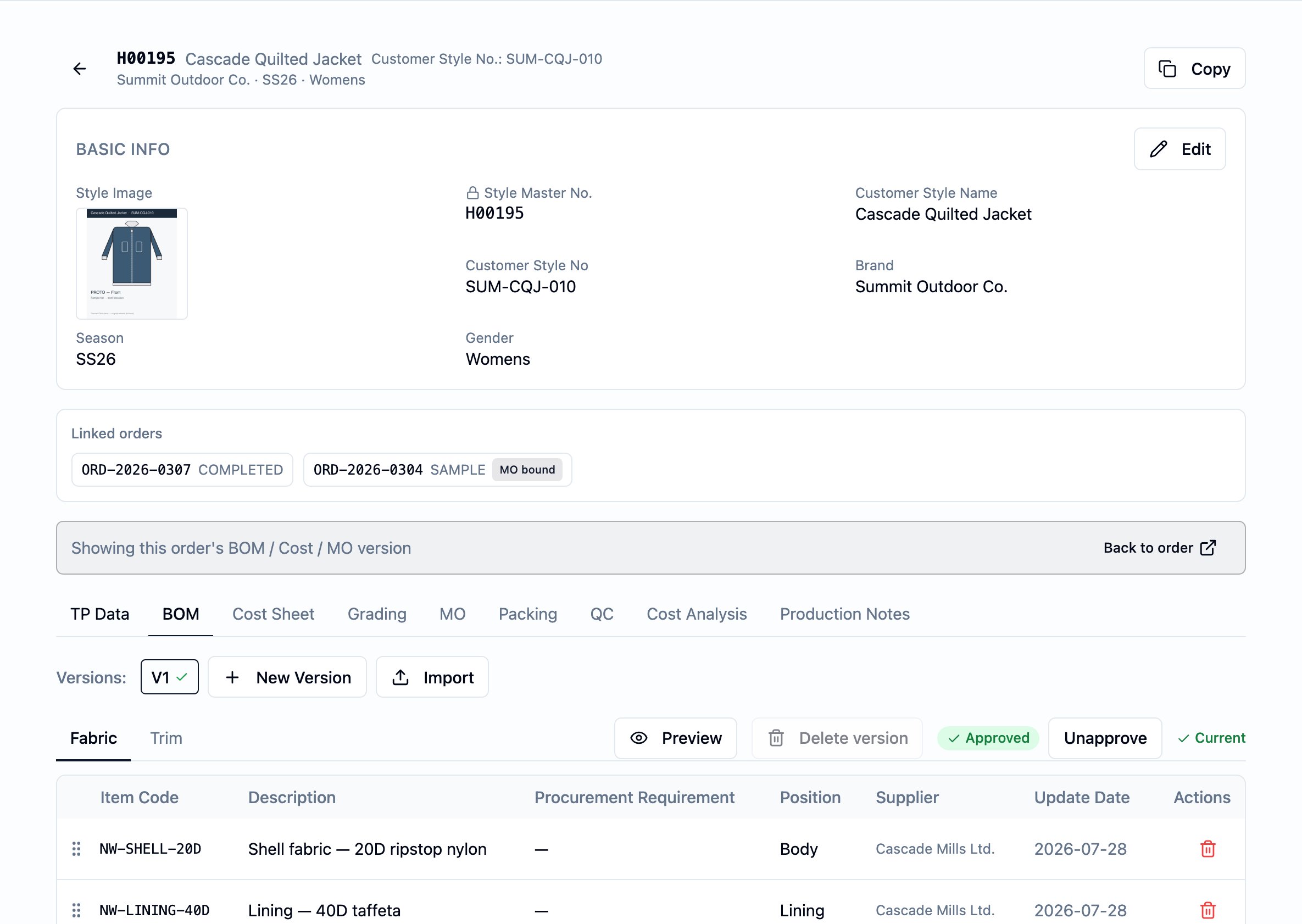
1. **Open the style's BOM tab.** Open the **Styles** module, open the
style, and go to the **BOM** tab. Existing versions appear in the
version list. If you are already working inside an order at the time,
the new version is tied to that order; otherwise it stays at style level.
 2. **Open a new BOM version.** Start a new version. It opens in **Draft**
with no lines, ready to be filled in.
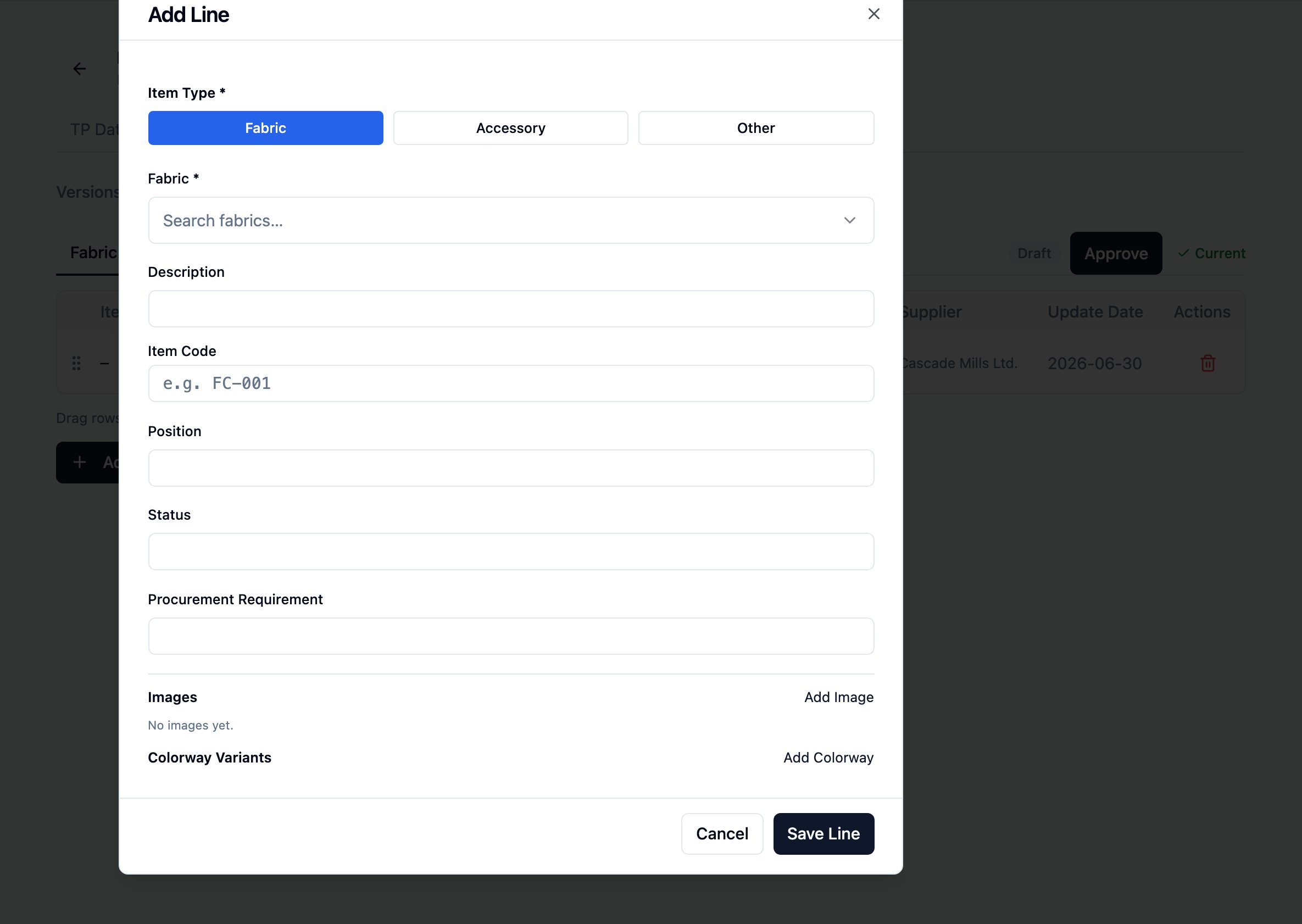
3. **Add a line.** Add one row per material the piece carries:
* Pick the line's `Type` — **fabric** or **accessory**. The picker for
the next field switches to match.
* Pick the **fabric master** or the **accessory master** the line is
built on. The supplier, lead time, and the master's item number come
from this record; the BOM line carries the link to the master, not a
free-text copy.
* Fill in `Description`. Lines without a linked master are allowed
while you are drafting, but pick the master before approval.
* Set `Qty per piece` and `Unit` — how much of the material one piece
uses, in the unit the rest of the system reads (the unit defaults to
`PCS`; change it on lines measured in yd, m, or another unit). The
cost sheet copies `Qty per piece` in as the per-piece usage.
* Optionally set `Position` (where on the garment the material sits),
`Status`, and `Procurement requirement` as free-text notes that
travel with the line.
* Optionally set `Item code` to override the master's item number —
use this when the style buys the material under a different code.
* Optionally override `Vendor` on the line — only when the line buys
from a vendor other than the master's default supplier.
* Optionally add **body colorways** to the line by picking from the
style's colorway list, and optionally set an `Accessory color` note
(副料顏色) on accessory lines. Attach any **line images** the BOM
needs to carry.
2. **Open a new BOM version.** Start a new version. It opens in **Draft**
with no lines, ready to be filled in.
3. **Add a line.** Add one row per material the piece carries:
* Pick the line's `Type` — **fabric** or **accessory**. The picker for
the next field switches to match.
* Pick the **fabric master** or the **accessory master** the line is
built on. The supplier, lead time, and the master's item number come
from this record; the BOM line carries the link to the master, not a
free-text copy.
* Fill in `Description`. Lines without a linked master are allowed
while you are drafting, but pick the master before approval.
* Set `Qty per piece` and `Unit` — how much of the material one piece
uses, in the unit the rest of the system reads (the unit defaults to
`PCS`; change it on lines measured in yd, m, or another unit). The
cost sheet copies `Qty per piece` in as the per-piece usage.
* Optionally set `Position` (where on the garment the material sits),
`Status`, and `Procurement requirement` as free-text notes that
travel with the line.
* Optionally set `Item code` to override the master's item number —
use this when the style buys the material under a different code.
* Optionally override `Vendor` on the line — only when the line buys
from a vendor other than the master's default supplier.
* Optionally add **body colorways** to the line by picking from the
style's colorway list, and optionally set an `Accessory color` note
(副料顏色) on accessory lines. Attach any **line images** the BOM
needs to carry.
 4. **Add the rest of the lines, and reorder them.** Add one row per
material. Drag-and-drop the lines into the order the cost sheet and the
downstream consumers should show them. The reorder is one-time per
version — the order you set is the order everyone reads.
5. **Review the list.** Walk the lines and check the linked master, the
`Qty per piece`, the unit, and the `Vendor` resolution on each. The
platform does not block approval of a list that is missing materials,
missing prices, or missing vendors — it is the merchandiser who decides
the list is ready.
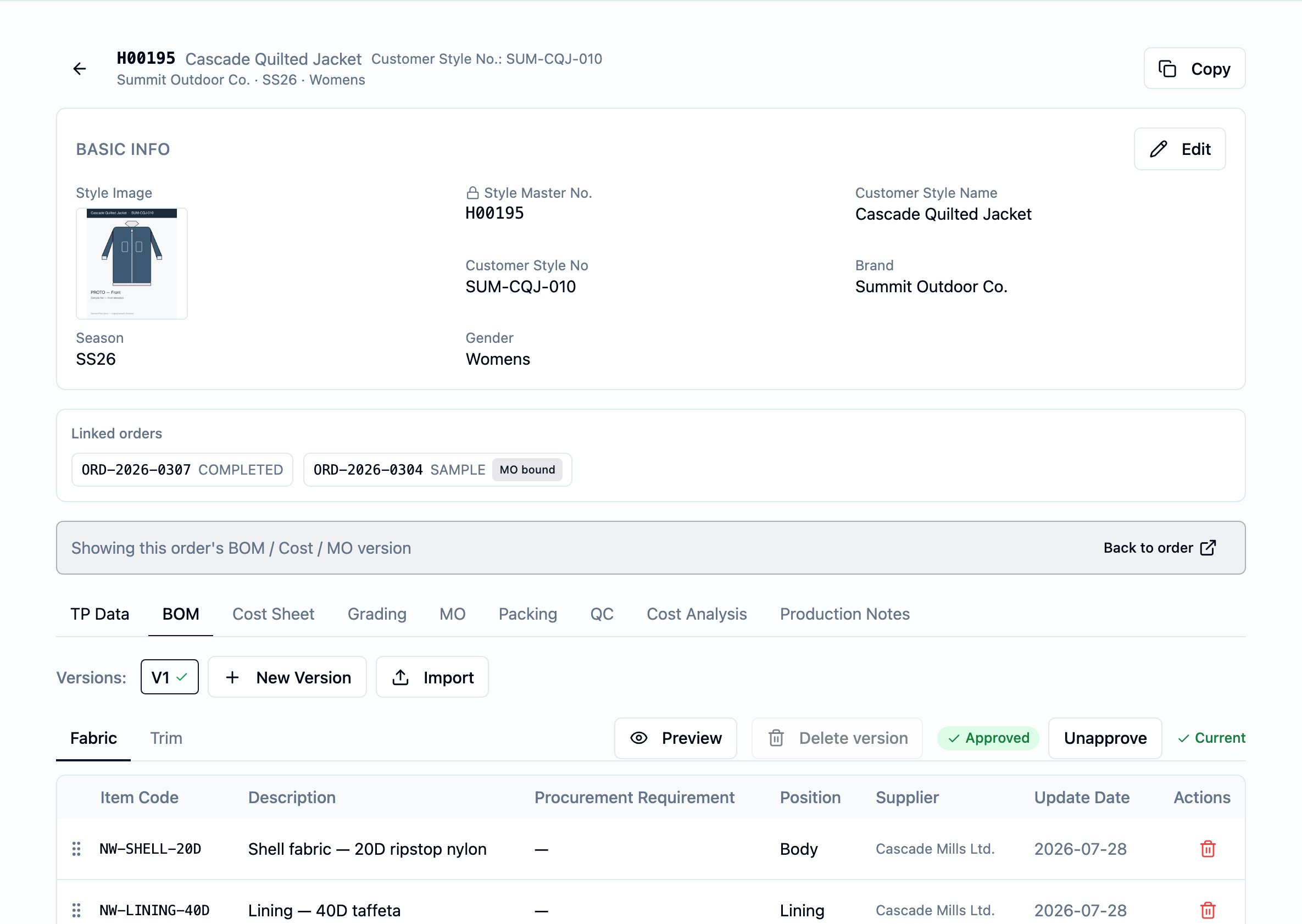
6. **Approve the version.** Press "Approve". The platform sets
`Approved by` and `Approved at`, writes a copy of each line's live master
identity (description, vendor name, category, lead time, item number)
onto the line so the approved version stays valid even if the master
changes later, and records the approval event.
4. **Add the rest of the lines, and reorder them.** Add one row per
material. Drag-and-drop the lines into the order the cost sheet and the
downstream consumers should show them. The reorder is one-time per
version — the order you set is the order everyone reads.
5. **Review the list.** Walk the lines and check the linked master, the
`Qty per piece`, the unit, and the `Vendor` resolution on each. The
platform does not block approval of a list that is missing materials,
missing prices, or missing vendors — it is the merchandiser who decides
the list is ready.
6. **Approve the version.** Press "Approve". The platform sets
`Approved by` and `Approved at`, writes a copy of each line's live master
identity (description, vendor name, category, lead time, item number)
onto the line so the approved version stays valid even if the master
changes later, and records the approval event.
 The downstream gates open from this point on:
* The [cost sheet](/modules/cost-sheet) can run **Copy from BOM** to
seed its fabric and accessory lines from this version.
* The platform can seed draft purchase orders against this version.
* The
[readiness engine](/reference/glossary#readiness-engine)
and the production-management preflight unlock the material side.
* On the **first approval** of a version that is tied to an order, the
order's phase advances to **Procurement**.
### Revert and re-approve
If an approved version needs a correction, **revert** it to **Draft**. The
platform clears `Approved by` and `Approved at`, and the version is open for
edit again. Fix the lines and approve once more — the captured line copies
re-capture on the next approve.
Reverting does **not** rewind the downstream effects of the prior approval:
any draft purchase order that was already generated against the prior
approved snapshot stays, and the order phase that the first approval
advanced stays where it is.
### Mint a new version instead
If the change is a material renegotiation rather than a correction — a new
fabric, a new supplier, a different trim — open a new BOM version rather
than reverting and re-approving. The prior version stays in history,
readable for the order or cost-sheet version it was the basis for, and the
new version takes over as current. See
[BOM, cost sheet, and artifact versions](/concepts/bom-cost-sheet-artifact-versions).
## Decision points
* **Style-level vs. tied to an order.** A version opened without an order
context is style-level. A version opened in an order context is tied to
that order, and the order's pin onto the BOM advances in lockstep when
the version is created, marked current, or switched. Both can coexist on
the same style.
* **Revert vs. mint a new version.** Revert for a correction on the same
version — the lines you have are still the right list. Mint a new
version when the material list itself has changed; the old version is
the audit trail for what an earlier cost sheet or order was built on.
* **Pick the master vs. type a free-text line.** Free-text works while you
are drafting, but draft purchase-order generation downstream drops a line
with no resolvable vendor. Pick the master before approval.
* **Per-line `Vendor` override vs. the master's default.** Use the override
only when this line genuinely buys from a different supplier than the
master's default; otherwise let the master's vendor stand.
## Business rules in play
These rules govern this workflow. They are documented once on the
[BOM page](/modules/bom); this workflow only summarizes.
* **A BOM version is one revision.** Each new version is its own BOM —
header plus its own lines — and starts in **Draft**. See
[Business rules](/modules/bom#business-rules) on the BOM page.
* **A line is either fabric or accessory.** Each line picks one material
from the corresponding master.
* **Approval captures a copy of each line's master identity.** The captured
copies (description, vendor name, category, lead time, item number) stay
with the line for as long as the version stands. Editing the master later
does not change them.
* **Approval is per version, on the order it is tied to.** Approving order
A's version does not approve order B's, even on the same style.
* **Reverting an approved version does not rewind downstream effects.**
Draft purchase orders already generated and order phases already
advanced stay.
* **Editing a line on an approved version is allowed**, but the captured
copies are not refreshed by the edit. Revert and re-approve, or mint a
new version, to refresh them.
* **A line without a linked master is dropped from draft purchase-order
generation downstream**, and reported as skipped.
## Dates set or affected
Approving a BOM version sets **`Approved at`** on the version to the moment
of approval. Reverting clears it. There are no other business dates on the
BOM — no target date, no effective-from, no expiry. Dates that bound an
order in business terms live on the
[order](/modules/orders), not on the BOM.
The header carries `Created` and `Last updated` for reference; the **Last
updated** value is what the BOM tab labels "Update date".
On the **first approval** of a version that is tied to an order, the order's
phase advances from **PO received** to **Procurement** — see
[Order lifecycle](/concepts/order-lifecycle) for the wider phase chain.
## What happens next
A saved, approved BOM version is the precondition for the rest of the
material side:
1. [Build the cost sheet](/modules/build-the-cost-sheet). Open a Draft
cost-sheet version on the style and press **Copy from BOM**. Each
fabric and accessory BOM line seeds one cost-sheet line, capturing the
description, item code, position, supplier, unit, per-piece usage, and
unit cost from the BOM line and its linked master. The cost line is
the source of truth for that material on the sheet from that moment.
2. **Generate draft purchase orders.** The approved BOM seeds a draft
purchase order for each vendor. Each PO line carries the BOM line's
material, the resolved vendor, the order's quantity for that line, and
the unit price captured from the linked master at approval. A BOM line
without a linked master carries no captured price; lines with no
resolvable vendor are dropped and reported as skipped. The draft purchase
orders are ready to review and issue from the **Production** side. See
[Production](/modules/production).
3. **Order phase advances on first approval.** When the version is tied
to an order and this is the first approval, the order's phase advances
to **Procurement** — the material side is signed off and the
downstream readiness work unblocks.
When the material list needs to change later, mint a new BOM version
rather than rewriting the old. Earlier versions stay readable for whatever
order or cost-sheet version is pointed at them. See
[BOM, cost sheet, and artifact versions](/concepts/bom-cost-sheet-artifact-versions).
## Best practices
* **Link a fabric or accessory master on every line before approval.** A
line without a linked master has no resolvable supplier and is dropped
from draft purchase-order generation. Pick the master, even if the line
is being added in a hurry.
* **Set `Qty per piece` deliberately.** The cost sheet copies it in as the
per-piece usage, and a placeholder value follows you into costing.
* **Reorder the lines once on the version.** The order you set is the
order the cost sheet and the BOM tab show; the rest of the system reads
from it.
* **Approve only when the list is complete.** The platform does not block
approval of an incomplete BOM, so the merchandiser is the gate. Approve
when the list is ready to defend.
* **Mint a new version for a material change rather than editing the old
one.** Editing the lines on an approved version is allowed but the
captured copies do not refresh on edit, and the old version is the audit
trail for what an earlier cost sheet or order was built on.
* **Use the per-line `Vendor` override only when the line genuinely buys
from a different supplier than the master's default.** One less moving
part to reconcile later.
## Related pages
* [BOM](/modules/bom)
* [Develop a style](/modules/develop-a-style)
* [Build the cost sheet](/modules/build-the-cost-sheet)
* [Cost Sheet](/modules/cost-sheet)
* [BOM, cost sheet, and artifact versions](/concepts/bom-cost-sheet-artifact-versions)
* [Production](/modules/production)
The downstream gates open from this point on:
* The [cost sheet](/modules/cost-sheet) can run **Copy from BOM** to
seed its fabric and accessory lines from this version.
* The platform can seed draft purchase orders against this version.
* The
[readiness engine](/reference/glossary#readiness-engine)
and the production-management preflight unlock the material side.
* On the **first approval** of a version that is tied to an order, the
order's phase advances to **Procurement**.
### Revert and re-approve
If an approved version needs a correction, **revert** it to **Draft**. The
platform clears `Approved by` and `Approved at`, and the version is open for
edit again. Fix the lines and approve once more — the captured line copies
re-capture on the next approve.
Reverting does **not** rewind the downstream effects of the prior approval:
any draft purchase order that was already generated against the prior
approved snapshot stays, and the order phase that the first approval
advanced stays where it is.
### Mint a new version instead
If the change is a material renegotiation rather than a correction — a new
fabric, a new supplier, a different trim — open a new BOM version rather
than reverting and re-approving. The prior version stays in history,
readable for the order or cost-sheet version it was the basis for, and the
new version takes over as current. See
[BOM, cost sheet, and artifact versions](/concepts/bom-cost-sheet-artifact-versions).
## Decision points
* **Style-level vs. tied to an order.** A version opened without an order
context is style-level. A version opened in an order context is tied to
that order, and the order's pin onto the BOM advances in lockstep when
the version is created, marked current, or switched. Both can coexist on
the same style.
* **Revert vs. mint a new version.** Revert for a correction on the same
version — the lines you have are still the right list. Mint a new
version when the material list itself has changed; the old version is
the audit trail for what an earlier cost sheet or order was built on.
* **Pick the master vs. type a free-text line.** Free-text works while you
are drafting, but draft purchase-order generation downstream drops a line
with no resolvable vendor. Pick the master before approval.
* **Per-line `Vendor` override vs. the master's default.** Use the override
only when this line genuinely buys from a different supplier than the
master's default; otherwise let the master's vendor stand.
## Business rules in play
These rules govern this workflow. They are documented once on the
[BOM page](/modules/bom); this workflow only summarizes.
* **A BOM version is one revision.** Each new version is its own BOM —
header plus its own lines — and starts in **Draft**. See
[Business rules](/modules/bom#business-rules) on the BOM page.
* **A line is either fabric or accessory.** Each line picks one material
from the corresponding master.
* **Approval captures a copy of each line's master identity.** The captured
copies (description, vendor name, category, lead time, item number) stay
with the line for as long as the version stands. Editing the master later
does not change them.
* **Approval is per version, on the order it is tied to.** Approving order
A's version does not approve order B's, even on the same style.
* **Reverting an approved version does not rewind downstream effects.**
Draft purchase orders already generated and order phases already
advanced stay.
* **Editing a line on an approved version is allowed**, but the captured
copies are not refreshed by the edit. Revert and re-approve, or mint a
new version, to refresh them.
* **A line without a linked master is dropped from draft purchase-order
generation downstream**, and reported as skipped.
## Dates set or affected
Approving a BOM version sets **`Approved at`** on the version to the moment
of approval. Reverting clears it. There are no other business dates on the
BOM — no target date, no effective-from, no expiry. Dates that bound an
order in business terms live on the
[order](/modules/orders), not on the BOM.
The header carries `Created` and `Last updated` for reference; the **Last
updated** value is what the BOM tab labels "Update date".
On the **first approval** of a version that is tied to an order, the order's
phase advances from **PO received** to **Procurement** — see
[Order lifecycle](/concepts/order-lifecycle) for the wider phase chain.
## What happens next
A saved, approved BOM version is the precondition for the rest of the
material side:
1. [Build the cost sheet](/modules/build-the-cost-sheet). Open a Draft
cost-sheet version on the style and press **Copy from BOM**. Each
fabric and accessory BOM line seeds one cost-sheet line, capturing the
description, item code, position, supplier, unit, per-piece usage, and
unit cost from the BOM line and its linked master. The cost line is
the source of truth for that material on the sheet from that moment.
2. **Generate draft purchase orders.** The approved BOM seeds a draft
purchase order for each vendor. Each PO line carries the BOM line's
material, the resolved vendor, the order's quantity for that line, and
the unit price captured from the linked master at approval. A BOM line
without a linked master carries no captured price; lines with no
resolvable vendor are dropped and reported as skipped. The draft purchase
orders are ready to review and issue from the **Production** side. See
[Production](/modules/production).
3. **Order phase advances on first approval.** When the version is tied
to an order and this is the first approval, the order's phase advances
to **Procurement** — the material side is signed off and the
downstream readiness work unblocks.
When the material list needs to change later, mint a new BOM version
rather than rewriting the old. Earlier versions stay readable for whatever
order or cost-sheet version is pointed at them. See
[BOM, cost sheet, and artifact versions](/concepts/bom-cost-sheet-artifact-versions).
## Best practices
* **Link a fabric or accessory master on every line before approval.** A
line without a linked master has no resolvable supplier and is dropped
from draft purchase-order generation. Pick the master, even if the line
is being added in a hurry.
* **Set `Qty per piece` deliberately.** The cost sheet copies it in as the
per-piece usage, and a placeholder value follows you into costing.
* **Reorder the lines once on the version.** The order you set is the
order the cost sheet and the BOM tab show; the rest of the system reads
from it.
* **Approve only when the list is complete.** The platform does not block
approval of an incomplete BOM, so the merchandiser is the gate. Approve
when the list is ready to defend.
* **Mint a new version for a material change rather than editing the old
one.** Editing the lines on an approved version is allowed but the
captured copies do not refresh on edit, and the old version is the audit
trail for what an earlier cost sheet or order was built on.
* **Use the per-line `Vendor` override only when the line genuinely buys
from a different supplier than the master's default.** One less moving
part to reconcile later.
## Related pages
* [BOM](/modules/bom)
* [Develop a style](/modules/develop-a-style)
* [Build the cost sheet](/modules/build-the-cost-sheet)
* [Cost Sheet](/modules/cost-sheet)
* [BOM, cost sheet, and artifact versions](/concepts/bom-cost-sheet-artifact-versions)
* [Production](/modules/production)