> ## Documentation Index
> Fetch the complete documentation index at: https://docs.garmentflow.ai/llms.txt
> Use this file to discover all available pages before exploring further.
# BOM
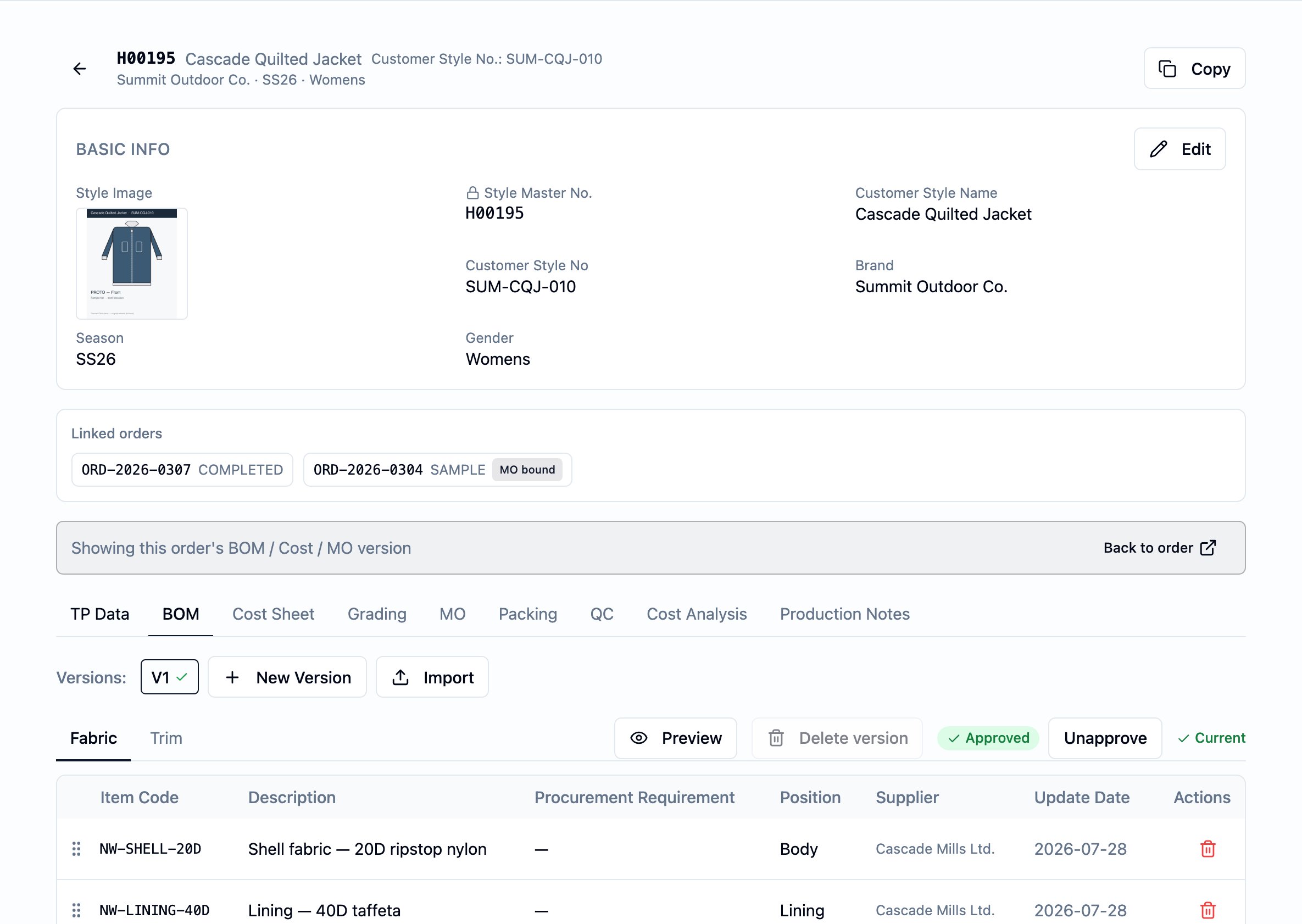
> The bill of materials a style is built from — the per-style, per-version list of fabrics and trims that production, purchasing, costing, and readiness all read.
A [BOM](/reference/glossary#bom-bill-of-materials)
is the material spine of a
[style](/reference/glossary#style):
the list of fabrics and trims needed to make one finished piece, captured per
version so the style can evolve while each earlier version stays intact for the
order it was built against.
 ## What it is
A BOM is **per-style, per-version**. One BOM is one revision of the style's
material list — every line on it is one fabric or one accessory that goes into
a single piece. The header carries the version's identity and approval state;
the lines carry the materials.
Each line names one material, where it sits on the garment, how much of it the
piece uses, and where it comes from. Lines pick their material from the
[fabric master](/reference/glossary#fabric-master)
or
[accessory master](/reference/glossary#accessory-master)
so the BOM, the cost sheet, and the purchase order downstream all refer to the
same record — not three free-text descriptions of it.
The BOM is the single source of truth for "what the piece is made of." The
[cost sheet](/modules/cost-sheet), purchase orders, the readiness engine, and
the production checks all read it.
## Why it exists
Apparel production runs off a settled material list. Costing needs to know
what materials roll into the per-piece build-up. Purchasing needs to know what
to buy, from which supplier, for which style. Production needs to know what
the cutter, the trim store, and the sewing line should expect. The readiness
engine needs to know whether the material side is signed off so it can tell
which work is unblocked. All four read the BOM, so the BOM has to be one
record everyone agrees on.
Versioning lets the material list change without losing the version an earlier
order was built against. Each revision is a new BOM version on the same
style — a renegotiated supplier, a swapped fabric, an added trim — while the
prior version stays readable for whatever order or cost-sheet version is
pointed at it.
## When it is used
* **During development**, to capture the fabrics and trims as the style takes
shape — the BOM is what the
[cost sheet](/modules/cost-sheet) copies its material lines from.
* **At the start of procurement**, to certify the material list so the system
can generate draft purchase orders against it.
* **On a reorder or a material change**, to mint a new version, edit the
list, and approve again — earlier versions stay intact.
The BOM lives on the style — open the style, go to the **BOM** tab.
## Dependencies
* A **style** — every BOM belongs to one. See
[Styles](/modules/styles).
* A [fabric master](/admin/master-catalogs#fabrics) record for each fabric
line, and an [accessory master](/admin/master-catalogs#accessories) record
for each accessory line. Free-text material descriptions are permitted, but
a line without a linked master has no resolvable supplier and is dropped by
purchase-order generation downstream.
* **BOM write permission**, for the user adding versions, editing lines, or
approving. Reads are open to any authenticated user in your tenant.
## What depends on it
* The style's **cost sheet** — the cost sheet seeds its fabric and accessory
lines by running **Copy from BOM** against the style's current BOM version.
See [Cost Sheet](/modules/cost-sheet) and
[Build the cost sheet](/modules/build-the-cost-sheet).
* **Draft purchase orders** — an approved BOM is what the platform reads to
seed a draft
[purchase order](/reference/glossary#po-purchase-order)
for each vendor. Each PO line carries the BOM line's material, the resolved
vendor, the order's quantity for that line, and the unit price captured from
the linked fabric or accessory master at approval. A BOM line without a
linked master has no price source and carries no captured price.
* The **readiness engine** and the production-management preflight — both
treat **Approved** as the gate that opens the material side of the work.
* The order's
[artifact-version](/reference/glossary#artifact-version)
pin onto the BOM — when an order's BOM version is created, marked current,
or switched, the order's pin advances in lockstep. See
[BOM, cost sheet, and artifact versions](/concepts/bom-cost-sheet-artifact-versions).
## Fields
The BOM's fields group into the **header** (identity, status, audit) and the
**lines** (each material on the piece). The header is shared across every
line; the line carries the material itself.
### Header — identity
* `Version` — the BOM's version number for the style. Assigned by the
platform when the version is created; starts at 1 on the first version and
increases by one on each new version on the same style, and on the same
order when the version is tied to one.
* `Style` — the parent style. Set when the version is created and not edited
afterwards.
* `Order` — the order the version is tied to, when the BOM was created in an
order context. When set, marking this version current advances that order's
pin onto the BOM. Optional; a style-level BOM has none.
### Header — status and audit
* `Status` — **Draft** or **Approved**. Set by the platform on transition;
not edited directly.
* `Approved by`, `Approved at` — the user and time the version was approved.
Set on transition to **Approved**; cleared if the version is reverted to
**Draft**.
* `Created`, `Last updated` — set by the platform. The **Last updated** value
is what the BOM tab labels "Update date".
### Lines — identity and display
Each line documents one material on the piece.
* `Description` — what the material is. **Required**, up to 300 characters.
* `Specification` — a free-text spec note. Optional, up to 300 characters.
* `Position` — where the material sits on the garment (e.g. body, collar,
cuff). Optional, up to 100 characters.
* `Status` — a free-text status note on the line (for example, "qualified",
"pending sample"). Optional, up to 50 characters.
* `Procurement requirement` — a free-text procurement note on the line.
Optional, up to 255 characters.
* `Sort order` — the line's position within the version. Drag-and-drop
reorder writes this.
### Lines — material
* `Type` — **fabric** or **accessory**. The line picks its material from the
corresponding master, and the type drives what runs on this line
downstream — only fabric and accessory lines are eligible for **Copy from
BOM** into the cost sheet.
* `Fabric` or `Accessory` — the material master picked for the line. A line
carries one or the other, not both. The vendor, lead time, item number, and
default unit price come from this record.
* `Item code` — the item number used downstream. Defaults to the master's
item number; you can override it on the line when this style buys the
material under a different code.
* `Body part` — a free-text indication of which body part the material is
used on. Optional.
* `Body colorway` — the structured per-line colorway list, picked from the
style's colorway list so the BOM line and the colorway it belongs to share
one identity. Each entry can override the item code, the vendor, and a
note.
* `Accessory color` — a free-text accessory color (副料顏色), set on
accessory lines.
### Lines — quantity and sourcing
* `Unit` — the unit `Qty per piece` is measured in (e.g. yd, pc, m). Defaults
to `PCS`.
* `Qty per piece` — how much of the material one piece of the style uses.
Per-piece, not per-order. The cost sheet copies this in as the line's
per-piece usage.
* `Vendor` — a per-line vendor override. When set, this takes precedence over
the default vendor on the linked fabric or accessory master.
### Lines — captured-at-approval copies
On **Approve**, the platform writes a copy of the live master's identity onto
the line so the approved version stays valid even if the master changes
later:
* `Description (captured)` — the live master's description at approval.
* `Vendor name (captured)` — the live master's vendor name at approval.
* `Category (captured)` — the live master's category at approval.
* `Lead time (captured)` — the live master's lead time at approval.
* `Item number (captured)` — the override if set, otherwise the live master's
item number at approval.
Capture only runs on **Approve**. Editing the master after approval does
not change the captured copies — they are the BOM line's record of what was
signed off.
### Lines — attachments
* `Line images` — per-line images uploaded against the line, ordered.
* `Body colorway` — see *Lines — material*.
An accessory line's approval round — the trim being sent out to a vendor
for sign-off before bulk — lives on
[Trim Submissions](/reference/glossary#trim-submission),
keyed to the same accessory master the BOM line picks. The submission is
the audit trail for trim approval; it does not gate the trim purchase
order. See [Trim Submissions](/modules/trim-submissions).
## Business rules
1. **A BOM version is one revision of the style's material list.** Each new
version on the style starts as a fresh BOM — header plus its own lines —
and the prior version stays intact. New versions begin in **Draft**.
2. **A version may be tied to an order or kept at style level.** When the
version is created in an
[order](/reference/glossary#order)
context, the version is tied to that order, and the order's pin onto the
BOM advances when the version is created, marked current, or switched.
Without that context, the version is style-level. The two coexist on the
same style.
3. **A line is either fabric or accessory.** Each line picks one material,
from the **fabric** master or the **accessory** master, chosen by the
line's `Type`. The picker enforces the choice at the row, so the line
carries a single material identity.
4. **Approval is per version, on the order it is tied to.** Because each
tied order keeps its own pin onto the BOM, approving order A's BOM
version does not approve order B's, even on the same style master.
Approving from the style level approves the version without advancing any
order pin.
5. **Approval captures the line snapshot.** On the **Draft → Approved**
transition, each line writes a copy of the live master's identity
(description, vendor name, category, lead time, item number) onto the
line. The captured copies stay with the line for as long as the version
stands; later edits to the master do not change them.
6. **Approving an already-approved version is a no-op, and so is reverting
an already-draft one.** Re-running either action on a version that is
already in the target state does not change anything and is not an error.
7. **Reverting an approved version to draft does not rewind its downstream
effects.** Any draft purchase order already generated from the approved
version stays. The advance of the order's phase that the first approval
triggered stays. Revert lets you re-enter edit mode and re-approve; it
does not roll back what the prior approval already set in motion.
8. **A new revision is a new version, not a re-approve of the old.** Open a
fresh version (which begins **Draft**) and approve it. The prior version
stays readable in history, and is no longer the current one — either for
the style as a whole or for the order the prior version was tied to.
9. **Write actions on the BOM are restricted.** Users with BOM write
permission create versions, add and edit lines, reorder, and approve or
revert. Reads are open to any authenticated user in your tenant.
10. **A fabric or accessory line without a linked master has no resolvable
supplier.** Free-text lines are permitted while the BOM is being put
together, but the
[purchase-order](/reference/glossary#po-purchase-order)
generation downstream drops a line with no resolvable vendor and reports
it as skipped.
## Validations
| When | Check | What happens if it fails |
| --------------------- | ------------------------------------------------------------------------------------------------------------------------------------------------ | ------------------------------------------------------------------------------- |
| Add or edit a line | `Description` is set and no longer than 300 characters | The save is rejected. |
| Add or edit a line | `Specification` ≤ 300, `Position` ≤ 100, `Status` ≤ 50, `Procurement requirement` ≤ 255, `Item code` ≤ 100, `Unit` ≤ 20, `Accessory color` ≤ 500 | The save is rejected on whichever field exceeds the limit. |
| Add or edit a line | `Qty per piece` is zero or more | The save is rejected. |
| Reorder lines | The reordered set references no unknown line | The reorder is rejected as "reorder list references unknown line(s)". |
| Reorder lines | The reordered set includes every line on the version exactly once | The reorder is rejected as "reorder list must include every line exactly once". |
| Open a BOM by version | The version belongs to the style and tenant, and a header exists for it | The read is rejected as "BOM not found for this version". |
There are **no** save-time validations that the BOM has at least one line, or
that every line has a vendor, before approval. The gates that enforce "has
lines" and "has vendor" run downstream — draft purchase-order generation
reports the lines it had to skip, and the readiness and preflight checks fail
closed when the BOM is not yet approved.
## Date logic
The BOM has one business-meaningful date:
* **`Approved at`** — the moment the version was approved. Set on the
**Draft → Approved** transition by the platform; cleared if the version is
reverted to **Draft**. The readiness engine and draft purchase-order
generation both treat **Approved** as their precondition, not the timestamp
itself.
The platform records two audit timestamps:
* **`Created`** — when the version was opened.
* **`Last updated`** — when the version was last written to. Shown on the BOM
tab as "Update date".
There is no BOM `Target` date, `Effective from` date, or `Valid until` date.
Dates that bound an order in business terms live on the
[order](/modules/orders), not on the BOM.
## Status and transitions
A BOM version has two statuses: **Draft** and **Approved**.
* **Draft** — the version is open for edit. Add, edit, reorder, and delete
lines; pick masters; set quantities and vendors. New versions start here.
* **Approved** — the version is signed off and reads as the certified
material list. The downstream consumers that gate on **Approved** — draft
purchase-order generation, the readiness engine, the production-management
preflight — are unlocked.
Transitions:
* (created) → **Draft**: a new BOM version always opens in **Draft**.
* **Draft → Approved**: a user with BOM-approval permission approves the
version. The platform sets `Approved by` and `Approved at`, captures each
line's master snapshot (see business rule 5), records the approval event,
and — when this is the first approval on the version and the version is
tied to an order — advances the
[order's phase](/concepts/order-lifecycle) from **PO received** to
**Procurement**.
* **Approved → Draft**: a user with BOM-approval permission reverts the
version to draft. The platform clears `Approved by` and `Approved at` and
records the revert event. Captured line copies stay on the lines; downstream
effects already produced (draft purchase orders, advanced order phase) are
not rewound.
Editing a line on an **Approved** version is permitted — neither the platform
nor the BOM tab blocks it — but the captured line copies are not refreshed by
the edit. To re-capture against the live master, revert the version and
re-approve, or open a new version, edit, and approve it.
Approving an already-approved version is a no-op, and reverting an
already-draft one is a no-op (business rule 6).
## Calculations
The BOM **does not produce a per-piece total cost** — the material build-up
rolls up on the
[cost sheet](/modules/cost-sheet), which copies its fabric and accessory
lines from the BOM and applies the per-line costs there.
What the BOM contributes to its downstream consumers:
* **To the cost sheet**, on **Copy from BOM**: each eligible BOM line seeds
one cost-sheet line — the cost sheet captures the BOM line's description,
item code, position, supplier, unit, per-piece usage, and unit cost on the
cost line, taking the supplier and unit cost from the linked fabric or
accessory master with the BOM line's captured copies as fallback. From
that moment on, the cost line is the source of truth for that material on
the sheet. See
[Cost Sheet — Effect of changes](/modules/cost-sheet#effect-of-changes).
* **To purchase-order generation**: an approved BOM seeds a draft
[purchase order](/reference/glossary#po-purchase-order)
per vendor. Each PO line carries the BOM line's material, the resolved
vendor, the order's quantity for that line, and the unit price captured from
the linked fabric or accessory master at approval. A BOM line without a
linked master has no price source, so the PO line carries no captured price;
a line with no resolvable vendor is dropped and reported as skipped.
* **To the readiness engine** and the production-management preflight: the
status (**Approved** or not) is the gate; neither reads the lines'
numerical values.
## Effect of changes
* **Edit a line on a Draft version.** The change is saved. Captured copies
remain empty until the version is approved.
* **Edit a line on an Approved version.** The change is saved on the line,
but the captured copies are not refreshed. The version is still the
approved one — to refresh the captured copies against the live master,
revert and re-approve, or open a new version.
* **Delete a line.** The line and its images and colorway entries are
removed from the version.
* **Change the fabric or accessory master a line points at.** The live
supplier shown on the BOM tab re-reads from the new master immediately;
the captured copies do not change.
* **Approve the version.** Each line writes a copy of the live master's
identity (see business rule 5). The downstream consumers that gate on
**Approved** are unlocked. When this is the first approval on the version
and the version is tied to an order, the order's phase advances from
**PO received** to **Procurement**.
* **Revert the version to draft.** `Approved by` and `Approved at` clear;
captured copies stay on the lines; downstream effects already produced
stay. The version is open for edit again.
* **Run Copy from BOM on a Draft cost-sheet version.** Each fabric and
accessory BOM line that is not already linked to a cost line seeds one
new cost-sheet line, capturing the BOM line's description, item code,
position, supplier, unit, per-piece usage, and unit cost. The cost line
becomes the source of truth for that material on the sheet from that
moment. Re-running Copy is safe: lines already linked to a BOM line are
left alone. See
[Cost Sheet](/modules/cost-sheet#effect-of-changes).
* **Generate draft purchase orders from the approved BOM.** The BOM seeds
one or more draft purchase orders. Each PO line carries the BOM line's
material, the resolved vendor, the order's quantity for that line, and the
unit price captured from the linked master at approval. A BOM line without
a linked master carries no captured price; a line with no resolvable vendor
is dropped and reported as skipped. A previously issued purchase order on
this order to the same vendor is not regenerated.
* **Open a new version.** A new **Draft** version is opened on the style and
becomes current; the previously current version is no longer the current
one but stays readable.
* **Mark a different version current.** The downstream consumers re-read
the new current version's status. The per-order pin advances in lockstep
when the version is tied to an order.
## Best practices
* **Link a fabric or accessory master on every line.** Free-text lines work
while you are putting the list together, but a line without a linked
master has no resolvable supplier and is dropped from draft purchase-order
generation. Pick the master before approval.
* **Set `Qty per piece` deliberately.** The cost sheet copies it in as the
per-piece usage, so a placeholder value follows you into costing.
* **Use the per-line `Vendor` override only when the line genuinely buys
from a different supplier than the master's default.** Otherwise let the
master's vendor stand — one less moving part.
* **Approve only when the list is complete.** The platform does not block
approval of an incomplete BOM; approval just captures the line copies and
opens the downstream gates. Capture only the list you are ready to defend.
* **Mint a new version for a material change rather than editing the old.**
The platform allows edits on an approved version but does not re-capture
the line copies on edit. A new version keeps the audit trail clean.
* **Reorder the lines once on the version.** The order you set is the order
the cost sheet, the BOM tab, and downstream consumers display.
## Related pages
* [Develop a style](/modules/develop-a-style)
* [Build the BOM](/modules/build-the-bom)
* [Cost Sheet](/modules/cost-sheet)
* [Build the cost sheet](/modules/build-the-cost-sheet)
* [BOM, cost sheet, and artifact versions](/concepts/bom-cost-sheet-artifact-versions)
* [Styles](/modules/styles)
* [Trim Submissions](/modules/trim-submissions)
## What it is
A BOM is **per-style, per-version**. One BOM is one revision of the style's
material list — every line on it is one fabric or one accessory that goes into
a single piece. The header carries the version's identity and approval state;
the lines carry the materials.
Each line names one material, where it sits on the garment, how much of it the
piece uses, and where it comes from. Lines pick their material from the
[fabric master](/reference/glossary#fabric-master)
or
[accessory master](/reference/glossary#accessory-master)
so the BOM, the cost sheet, and the purchase order downstream all refer to the
same record — not three free-text descriptions of it.
The BOM is the single source of truth for "what the piece is made of." The
[cost sheet](/modules/cost-sheet), purchase orders, the readiness engine, and
the production checks all read it.
## Why it exists
Apparel production runs off a settled material list. Costing needs to know
what materials roll into the per-piece build-up. Purchasing needs to know what
to buy, from which supplier, for which style. Production needs to know what
the cutter, the trim store, and the sewing line should expect. The readiness
engine needs to know whether the material side is signed off so it can tell
which work is unblocked. All four read the BOM, so the BOM has to be one
record everyone agrees on.
Versioning lets the material list change without losing the version an earlier
order was built against. Each revision is a new BOM version on the same
style — a renegotiated supplier, a swapped fabric, an added trim — while the
prior version stays readable for whatever order or cost-sheet version is
pointed at it.
## When it is used
* **During development**, to capture the fabrics and trims as the style takes
shape — the BOM is what the
[cost sheet](/modules/cost-sheet) copies its material lines from.
* **At the start of procurement**, to certify the material list so the system
can generate draft purchase orders against it.
* **On a reorder or a material change**, to mint a new version, edit the
list, and approve again — earlier versions stay intact.
The BOM lives on the style — open the style, go to the **BOM** tab.
## Dependencies
* A **style** — every BOM belongs to one. See
[Styles](/modules/styles).
* A [fabric master](/admin/master-catalogs#fabrics) record for each fabric
line, and an [accessory master](/admin/master-catalogs#accessories) record
for each accessory line. Free-text material descriptions are permitted, but
a line without a linked master has no resolvable supplier and is dropped by
purchase-order generation downstream.
* **BOM write permission**, for the user adding versions, editing lines, or
approving. Reads are open to any authenticated user in your tenant.
## What depends on it
* The style's **cost sheet** — the cost sheet seeds its fabric and accessory
lines by running **Copy from BOM** against the style's current BOM version.
See [Cost Sheet](/modules/cost-sheet) and
[Build the cost sheet](/modules/build-the-cost-sheet).
* **Draft purchase orders** — an approved BOM is what the platform reads to
seed a draft
[purchase order](/reference/glossary#po-purchase-order)
for each vendor. Each PO line carries the BOM line's material, the resolved
vendor, the order's quantity for that line, and the unit price captured from
the linked fabric or accessory master at approval. A BOM line without a
linked master has no price source and carries no captured price.
* The **readiness engine** and the production-management preflight — both
treat **Approved** as the gate that opens the material side of the work.
* The order's
[artifact-version](/reference/glossary#artifact-version)
pin onto the BOM — when an order's BOM version is created, marked current,
or switched, the order's pin advances in lockstep. See
[BOM, cost sheet, and artifact versions](/concepts/bom-cost-sheet-artifact-versions).
## Fields
The BOM's fields group into the **header** (identity, status, audit) and the
**lines** (each material on the piece). The header is shared across every
line; the line carries the material itself.
### Header — identity
* `Version` — the BOM's version number for the style. Assigned by the
platform when the version is created; starts at 1 on the first version and
increases by one on each new version on the same style, and on the same
order when the version is tied to one.
* `Style` — the parent style. Set when the version is created and not edited
afterwards.
* `Order` — the order the version is tied to, when the BOM was created in an
order context. When set, marking this version current advances that order's
pin onto the BOM. Optional; a style-level BOM has none.
### Header — status and audit
* `Status` — **Draft** or **Approved**. Set by the platform on transition;
not edited directly.
* `Approved by`, `Approved at` — the user and time the version was approved.
Set on transition to **Approved**; cleared if the version is reverted to
**Draft**.
* `Created`, `Last updated` — set by the platform. The **Last updated** value
is what the BOM tab labels "Update date".
### Lines — identity and display
Each line documents one material on the piece.
* `Description` — what the material is. **Required**, up to 300 characters.
* `Specification` — a free-text spec note. Optional, up to 300 characters.
* `Position` — where the material sits on the garment (e.g. body, collar,
cuff). Optional, up to 100 characters.
* `Status` — a free-text status note on the line (for example, "qualified",
"pending sample"). Optional, up to 50 characters.
* `Procurement requirement` — a free-text procurement note on the line.
Optional, up to 255 characters.
* `Sort order` — the line's position within the version. Drag-and-drop
reorder writes this.
### Lines — material
* `Type` — **fabric** or **accessory**. The line picks its material from the
corresponding master, and the type drives what runs on this line
downstream — only fabric and accessory lines are eligible for **Copy from
BOM** into the cost sheet.
* `Fabric` or `Accessory` — the material master picked for the line. A line
carries one or the other, not both. The vendor, lead time, item number, and
default unit price come from this record.
* `Item code` — the item number used downstream. Defaults to the master's
item number; you can override it on the line when this style buys the
material under a different code.
* `Body part` — a free-text indication of which body part the material is
used on. Optional.
* `Body colorway` — the structured per-line colorway list, picked from the
style's colorway list so the BOM line and the colorway it belongs to share
one identity. Each entry can override the item code, the vendor, and a
note.
* `Accessory color` — a free-text accessory color (副料顏色), set on
accessory lines.
### Lines — quantity and sourcing
* `Unit` — the unit `Qty per piece` is measured in (e.g. yd, pc, m). Defaults
to `PCS`.
* `Qty per piece` — how much of the material one piece of the style uses.
Per-piece, not per-order. The cost sheet copies this in as the line's
per-piece usage.
* `Vendor` — a per-line vendor override. When set, this takes precedence over
the default vendor on the linked fabric or accessory master.
### Lines — captured-at-approval copies
On **Approve**, the platform writes a copy of the live master's identity onto
the line so the approved version stays valid even if the master changes
later:
* `Description (captured)` — the live master's description at approval.
* `Vendor name (captured)` — the live master's vendor name at approval.
* `Category (captured)` — the live master's category at approval.
* `Lead time (captured)` — the live master's lead time at approval.
* `Item number (captured)` — the override if set, otherwise the live master's
item number at approval.
Capture only runs on **Approve**. Editing the master after approval does
not change the captured copies — they are the BOM line's record of what was
signed off.
### Lines — attachments
* `Line images` — per-line images uploaded against the line, ordered.
* `Body colorway` — see *Lines — material*.
An accessory line's approval round — the trim being sent out to a vendor
for sign-off before bulk — lives on
[Trim Submissions](/reference/glossary#trim-submission),
keyed to the same accessory master the BOM line picks. The submission is
the audit trail for trim approval; it does not gate the trim purchase
order. See [Trim Submissions](/modules/trim-submissions).
## Business rules
1. **A BOM version is one revision of the style's material list.** Each new
version on the style starts as a fresh BOM — header plus its own lines —
and the prior version stays intact. New versions begin in **Draft**.
2. **A version may be tied to an order or kept at style level.** When the
version is created in an
[order](/reference/glossary#order)
context, the version is tied to that order, and the order's pin onto the
BOM advances when the version is created, marked current, or switched.
Without that context, the version is style-level. The two coexist on the
same style.
3. **A line is either fabric or accessory.** Each line picks one material,
from the **fabric** master or the **accessory** master, chosen by the
line's `Type`. The picker enforces the choice at the row, so the line
carries a single material identity.
4. **Approval is per version, on the order it is tied to.** Because each
tied order keeps its own pin onto the BOM, approving order A's BOM
version does not approve order B's, even on the same style master.
Approving from the style level approves the version without advancing any
order pin.
5. **Approval captures the line snapshot.** On the **Draft → Approved**
transition, each line writes a copy of the live master's identity
(description, vendor name, category, lead time, item number) onto the
line. The captured copies stay with the line for as long as the version
stands; later edits to the master do not change them.
6. **Approving an already-approved version is a no-op, and so is reverting
an already-draft one.** Re-running either action on a version that is
already in the target state does not change anything and is not an error.
7. **Reverting an approved version to draft does not rewind its downstream
effects.** Any draft purchase order already generated from the approved
version stays. The advance of the order's phase that the first approval
triggered stays. Revert lets you re-enter edit mode and re-approve; it
does not roll back what the prior approval already set in motion.
8. **A new revision is a new version, not a re-approve of the old.** Open a
fresh version (which begins **Draft**) and approve it. The prior version
stays readable in history, and is no longer the current one — either for
the style as a whole or for the order the prior version was tied to.
9. **Write actions on the BOM are restricted.** Users with BOM write
permission create versions, add and edit lines, reorder, and approve or
revert. Reads are open to any authenticated user in your tenant.
10. **A fabric or accessory line without a linked master has no resolvable
supplier.** Free-text lines are permitted while the BOM is being put
together, but the
[purchase-order](/reference/glossary#po-purchase-order)
generation downstream drops a line with no resolvable vendor and reports
it as skipped.
## Validations
| When | Check | What happens if it fails |
| --------------------- | ------------------------------------------------------------------------------------------------------------------------------------------------ | ------------------------------------------------------------------------------- |
| Add or edit a line | `Description` is set and no longer than 300 characters | The save is rejected. |
| Add or edit a line | `Specification` ≤ 300, `Position` ≤ 100, `Status` ≤ 50, `Procurement requirement` ≤ 255, `Item code` ≤ 100, `Unit` ≤ 20, `Accessory color` ≤ 500 | The save is rejected on whichever field exceeds the limit. |
| Add or edit a line | `Qty per piece` is zero or more | The save is rejected. |
| Reorder lines | The reordered set references no unknown line | The reorder is rejected as "reorder list references unknown line(s)". |
| Reorder lines | The reordered set includes every line on the version exactly once | The reorder is rejected as "reorder list must include every line exactly once". |
| Open a BOM by version | The version belongs to the style and tenant, and a header exists for it | The read is rejected as "BOM not found for this version". |
There are **no** save-time validations that the BOM has at least one line, or
that every line has a vendor, before approval. The gates that enforce "has
lines" and "has vendor" run downstream — draft purchase-order generation
reports the lines it had to skip, and the readiness and preflight checks fail
closed when the BOM is not yet approved.
## Date logic
The BOM has one business-meaningful date:
* **`Approved at`** — the moment the version was approved. Set on the
**Draft → Approved** transition by the platform; cleared if the version is
reverted to **Draft**. The readiness engine and draft purchase-order
generation both treat **Approved** as their precondition, not the timestamp
itself.
The platform records two audit timestamps:
* **`Created`** — when the version was opened.
* **`Last updated`** — when the version was last written to. Shown on the BOM
tab as "Update date".
There is no BOM `Target` date, `Effective from` date, or `Valid until` date.
Dates that bound an order in business terms live on the
[order](/modules/orders), not on the BOM.
## Status and transitions
A BOM version has two statuses: **Draft** and **Approved**.
* **Draft** — the version is open for edit. Add, edit, reorder, and delete
lines; pick masters; set quantities and vendors. New versions start here.
* **Approved** — the version is signed off and reads as the certified
material list. The downstream consumers that gate on **Approved** — draft
purchase-order generation, the readiness engine, the production-management
preflight — are unlocked.
Transitions:
* (created) → **Draft**: a new BOM version always opens in **Draft**.
* **Draft → Approved**: a user with BOM-approval permission approves the
version. The platform sets `Approved by` and `Approved at`, captures each
line's master snapshot (see business rule 5), records the approval event,
and — when this is the first approval on the version and the version is
tied to an order — advances the
[order's phase](/concepts/order-lifecycle) from **PO received** to
**Procurement**.
* **Approved → Draft**: a user with BOM-approval permission reverts the
version to draft. The platform clears `Approved by` and `Approved at` and
records the revert event. Captured line copies stay on the lines; downstream
effects already produced (draft purchase orders, advanced order phase) are
not rewound.
Editing a line on an **Approved** version is permitted — neither the platform
nor the BOM tab blocks it — but the captured line copies are not refreshed by
the edit. To re-capture against the live master, revert the version and
re-approve, or open a new version, edit, and approve it.
Approving an already-approved version is a no-op, and reverting an
already-draft one is a no-op (business rule 6).
## Calculations
The BOM **does not produce a per-piece total cost** — the material build-up
rolls up on the
[cost sheet](/modules/cost-sheet), which copies its fabric and accessory
lines from the BOM and applies the per-line costs there.
What the BOM contributes to its downstream consumers:
* **To the cost sheet**, on **Copy from BOM**: each eligible BOM line seeds
one cost-sheet line — the cost sheet captures the BOM line's description,
item code, position, supplier, unit, per-piece usage, and unit cost on the
cost line, taking the supplier and unit cost from the linked fabric or
accessory master with the BOM line's captured copies as fallback. From
that moment on, the cost line is the source of truth for that material on
the sheet. See
[Cost Sheet — Effect of changes](/modules/cost-sheet#effect-of-changes).
* **To purchase-order generation**: an approved BOM seeds a draft
[purchase order](/reference/glossary#po-purchase-order)
per vendor. Each PO line carries the BOM line's material, the resolved
vendor, the order's quantity for that line, and the unit price captured from
the linked fabric or accessory master at approval. A BOM line without a
linked master has no price source, so the PO line carries no captured price;
a line with no resolvable vendor is dropped and reported as skipped.
* **To the readiness engine** and the production-management preflight: the
status (**Approved** or not) is the gate; neither reads the lines'
numerical values.
## Effect of changes
* **Edit a line on a Draft version.** The change is saved. Captured copies
remain empty until the version is approved.
* **Edit a line on an Approved version.** The change is saved on the line,
but the captured copies are not refreshed. The version is still the
approved one — to refresh the captured copies against the live master,
revert and re-approve, or open a new version.
* **Delete a line.** The line and its images and colorway entries are
removed from the version.
* **Change the fabric or accessory master a line points at.** The live
supplier shown on the BOM tab re-reads from the new master immediately;
the captured copies do not change.
* **Approve the version.** Each line writes a copy of the live master's
identity (see business rule 5). The downstream consumers that gate on
**Approved** are unlocked. When this is the first approval on the version
and the version is tied to an order, the order's phase advances from
**PO received** to **Procurement**.
* **Revert the version to draft.** `Approved by` and `Approved at` clear;
captured copies stay on the lines; downstream effects already produced
stay. The version is open for edit again.
* **Run Copy from BOM on a Draft cost-sheet version.** Each fabric and
accessory BOM line that is not already linked to a cost line seeds one
new cost-sheet line, capturing the BOM line's description, item code,
position, supplier, unit, per-piece usage, and unit cost. The cost line
becomes the source of truth for that material on the sheet from that
moment. Re-running Copy is safe: lines already linked to a BOM line are
left alone. See
[Cost Sheet](/modules/cost-sheet#effect-of-changes).
* **Generate draft purchase orders from the approved BOM.** The BOM seeds
one or more draft purchase orders. Each PO line carries the BOM line's
material, the resolved vendor, the order's quantity for that line, and the
unit price captured from the linked master at approval. A BOM line without
a linked master carries no captured price; a line with no resolvable vendor
is dropped and reported as skipped. A previously issued purchase order on
this order to the same vendor is not regenerated.
* **Open a new version.** A new **Draft** version is opened on the style and
becomes current; the previously current version is no longer the current
one but stays readable.
* **Mark a different version current.** The downstream consumers re-read
the new current version's status. The per-order pin advances in lockstep
when the version is tied to an order.
## Best practices
* **Link a fabric or accessory master on every line.** Free-text lines work
while you are putting the list together, but a line without a linked
master has no resolvable supplier and is dropped from draft purchase-order
generation. Pick the master before approval.
* **Set `Qty per piece` deliberately.** The cost sheet copies it in as the
per-piece usage, so a placeholder value follows you into costing.
* **Use the per-line `Vendor` override only when the line genuinely buys
from a different supplier than the master's default.** Otherwise let the
master's vendor stand — one less moving part.
* **Approve only when the list is complete.** The platform does not block
approval of an incomplete BOM; approval just captures the line copies and
opens the downstream gates. Capture only the list you are ready to defend.
* **Mint a new version for a material change rather than editing the old.**
The platform allows edits on an approved version but does not re-capture
the line copies on edit. A new version keeps the audit trail clean.
* **Reorder the lines once on the version.** The order you set is the order
the cost sheet, the BOM tab, and downstream consumers display.
## Related pages
* [Develop a style](/modules/develop-a-style)
* [Build the BOM](/modules/build-the-bom)
* [Cost Sheet](/modules/cost-sheet)
* [Build the cost sheet](/modules/build-the-cost-sheet)
* [BOM, cost sheet, and artifact versions](/concepts/bom-cost-sheet-artifact-versions)
* [Styles](/modules/styles)
* [Trim Submissions](/modules/trim-submissions)